


Hi, this is Darius. A new website feels like the finish line, but launch day is often followed by silence, with no visitors and no orders. Usually the site is fine and Google simply has no reason to show it to anyone yet.
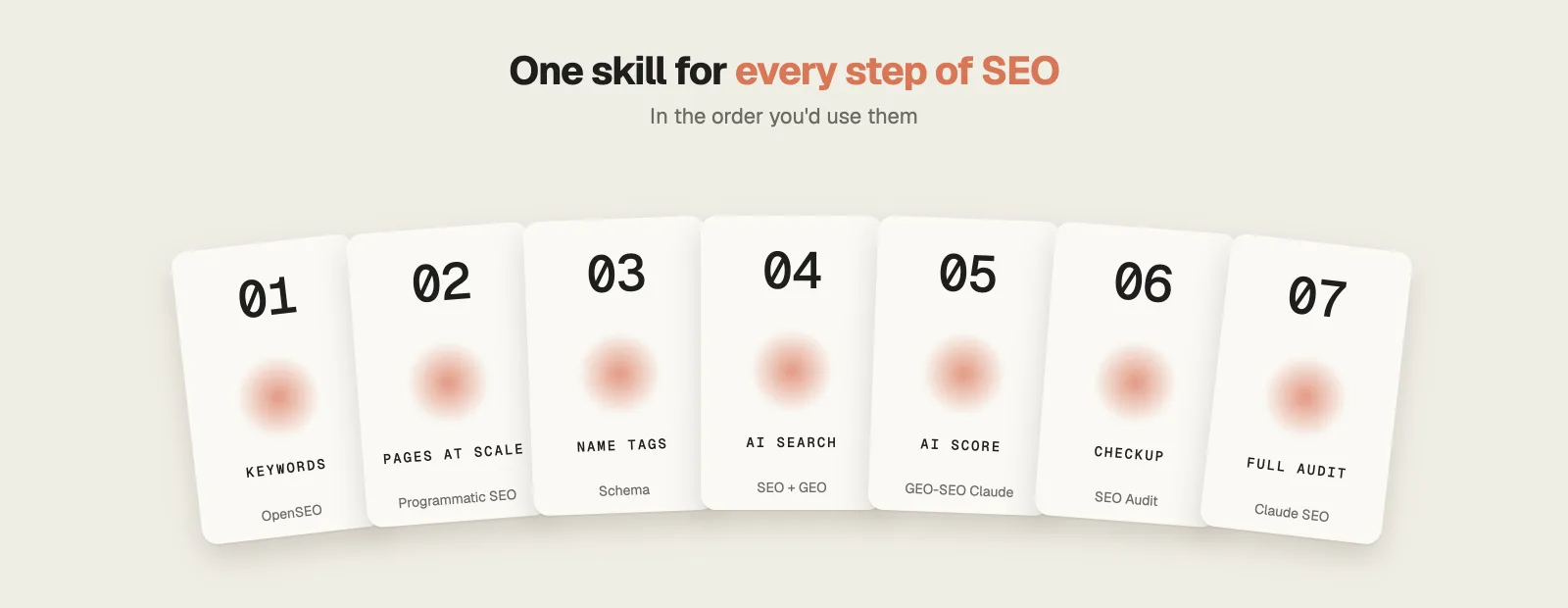
That reason is SEO, and Claude SEO skills now handle most of the work for you. These are the 7 I’d use, in the order you’d need them: finding searches, building pages, labeling them, getting named by AI and checking the whole site. Each section covers what the skill does, an example, the cost and the catch.
How popular are these Claude SEO skills?
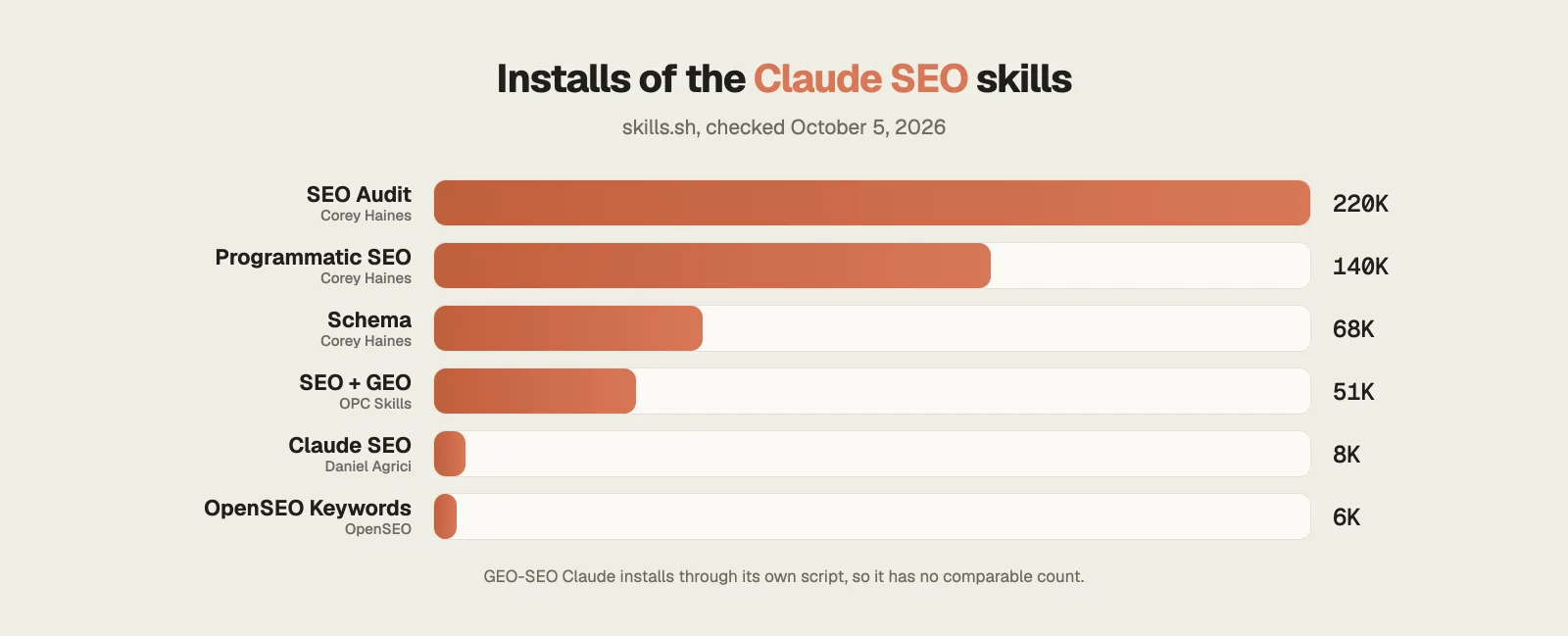
Install counts show what people rely on. SEO Audit leads by a wide margin with over 220,000 installs, and two other skills from the same pack follow it.
Step 1 · Keywords
1. OpenSEO Keyword Research: find the searches you can win
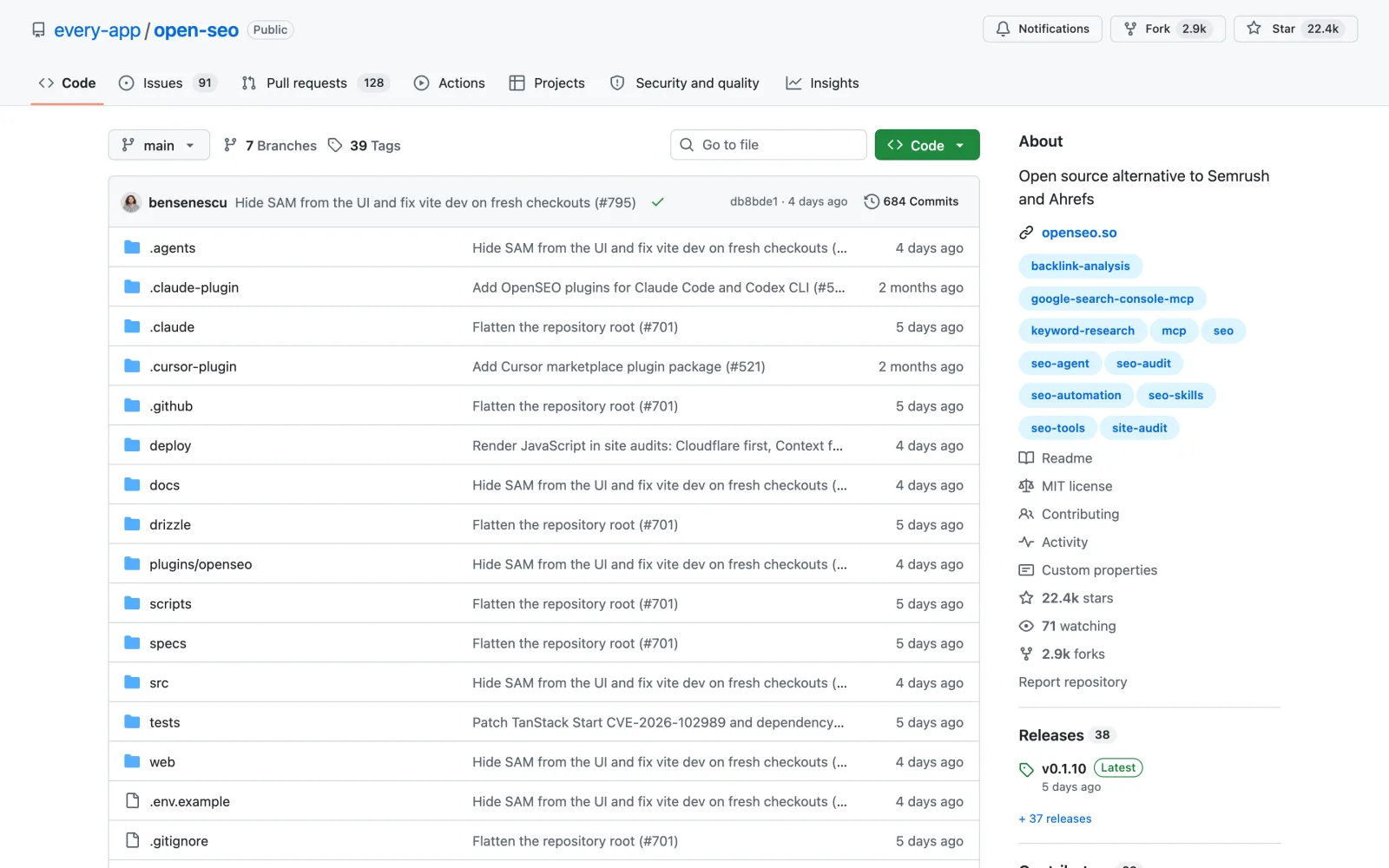
22.4K GitHub stars5.7K installsMITFree skill, paid data
A page can be well written and still get no visits, because nobody searches for the words on it.
OpenSEO is an open source answer to paid suites like Semrush and Ahrefs. Its keyword research skill handles the first job of any SEO plan: finding out what people type into Google.
What it does
- Give it a topic and it returns up to 150 keyword ideas in one call.
- Each idea comes with monthly search volume, keyword difficulty (how hard page one is) and the intent behind the search, such as buying or learning.
- The list is ranked by real opportunity, so a fit with your business counts as much as raw volume.
- Metrics are never guessed. If the data source returns nothing, the report says “unknown”.
Example: A bakery owner types in “birthday cakes” and gets back a short list of local searches with buyer intent, the kind a small site can reach page one for.
The catch: The numbers come from DataForSEO, which charges per request. The hosted OpenSEO plan costs $10 a month and adds 28% on top of the DataForSEO cost.
Install it
Easiest: open Claude Code, type Install this skill: and paste github.com/every-app/open-seo
npx skills add every-app/open-seo --skill keyword-researchStep 2 · Pages at scale
2. Programmatic SEO: one template, many useful pages
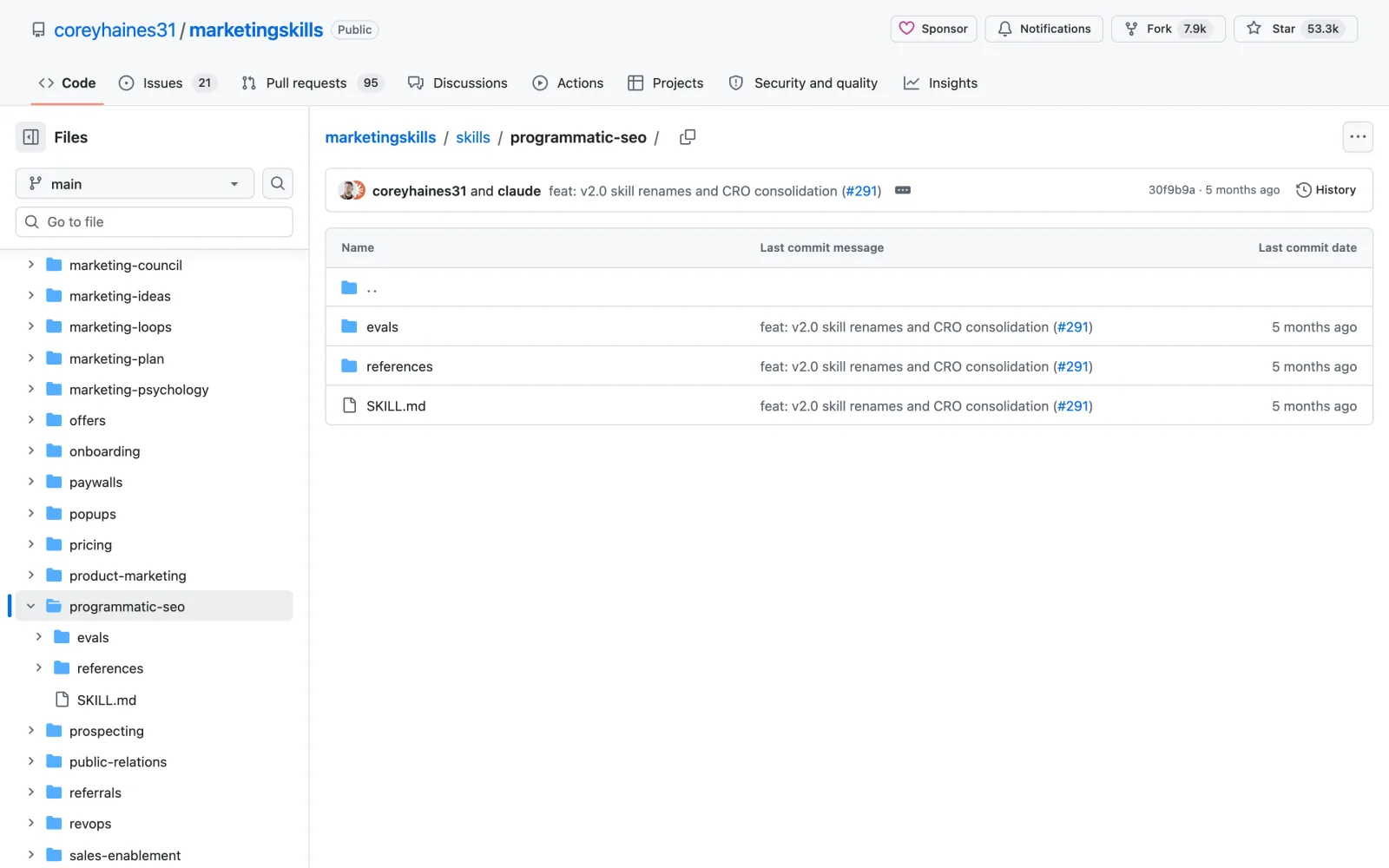
53.2K GitHub stars (pack)140K installsMITFree
Sites with a page for every city or every comparison didn’t write each one by hand. They built a template and filled it with data.
Programmatic SEO comes from Corey Haines’ Marketing Skills pack. It plans and builds batches of pages from one template plus a dataset.
What it does
- There are 12 playbooks to work from, among them comparison pages (X vs Y), location pages and glossary pages that explain a term.
- Before writing anything, it asks what data you have, because data nobody else has beats data anyone can scrape.
- Its guiding rule is that 100 strong pages are worth more than 10,000 thin ones.
- Each page gets its own details, so it doesn’t read like a copy with one word changed.
Example: A bakery that makes wedding, birthday and baby shower cakes gets a planned page for each occasion, each with its own photos, prices and common questions.
The catch: Google’s spam policies cover scaled content abuse. If every page is the same text with a swapped keyword, you risk being treated as spam, so each page needs real information of its own.
Install it
Easiest: open Claude Code, type Install this skill: and paste github.com/coreyhaines31/marketingskills/tree/main/skills/programmatic-seo
npx skills add https://github.com/coreyhaines31/marketingskills --skill programmatic-seoStep 3 · Name tags
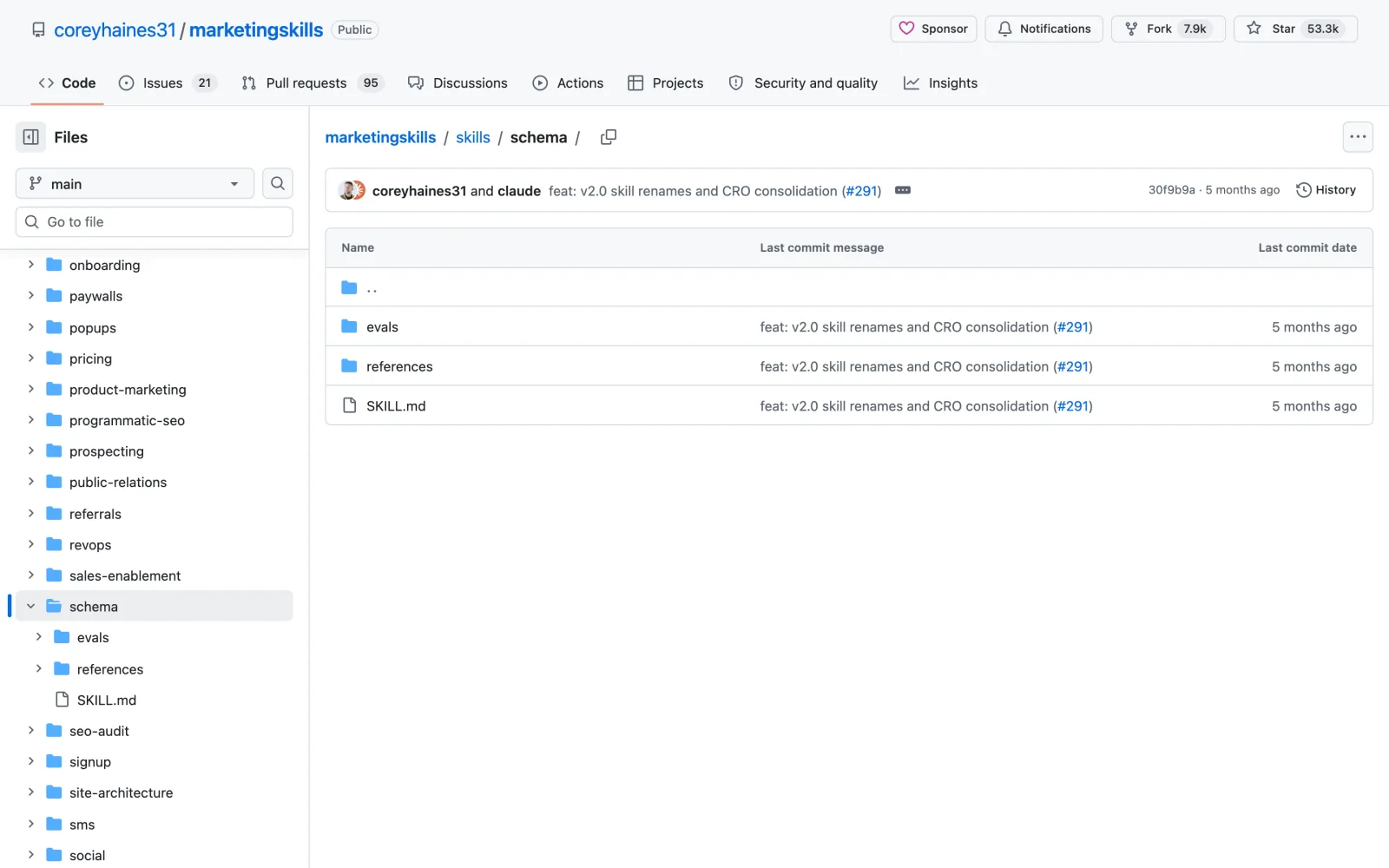
3. Schema: schema markup Google can read
53.2K GitHub stars (pack)67.6K installsMITFree
Some search results show star ratings, prices and opening hours under the title. Most small sites get a plain blue link.
Those extras come from structured data, often called schema. It works like a label that tells Google exactly what a page is about. Corey Haines’ Schema skill writes it for you.
What it does
- The output is JSON-LD, the format Google recommends.
- The type comes from a table of ten common ones, including local business, product, article, event and FAQ.
- Only content that actually appears on the page gets marked up.
- Before anything goes live, you test it in Google’s Rich Results Test.
Example: Give it a bakery’s contact page and you get a ready-to-paste block with the business type, address, phone number and opening hours.
The catch: Even with correct markup, Google’s own guidelines say it may or may not show rich results for a page.
Install it
Easiest: open Claude Code, type Install this skill: and paste github.com/coreyhaines31/marketingskills/tree/main/skills/schema
npx skills add https://github.com/coreyhaines31/marketingskills --skill schemaCorey Haines’ pack also has an AI SEO skill, covered in my guide to Claude skills for marketing.
Step 4 · AI search
4. SEO + GEO: SEO plus GEO in one skill
1.8K GitHub stars50.6K installsApache-2.0Free
Ask ChatGPT for a good bakery nearby and you get one or two names, not ten blue links. If you’re not one of them, that person never hears about you.
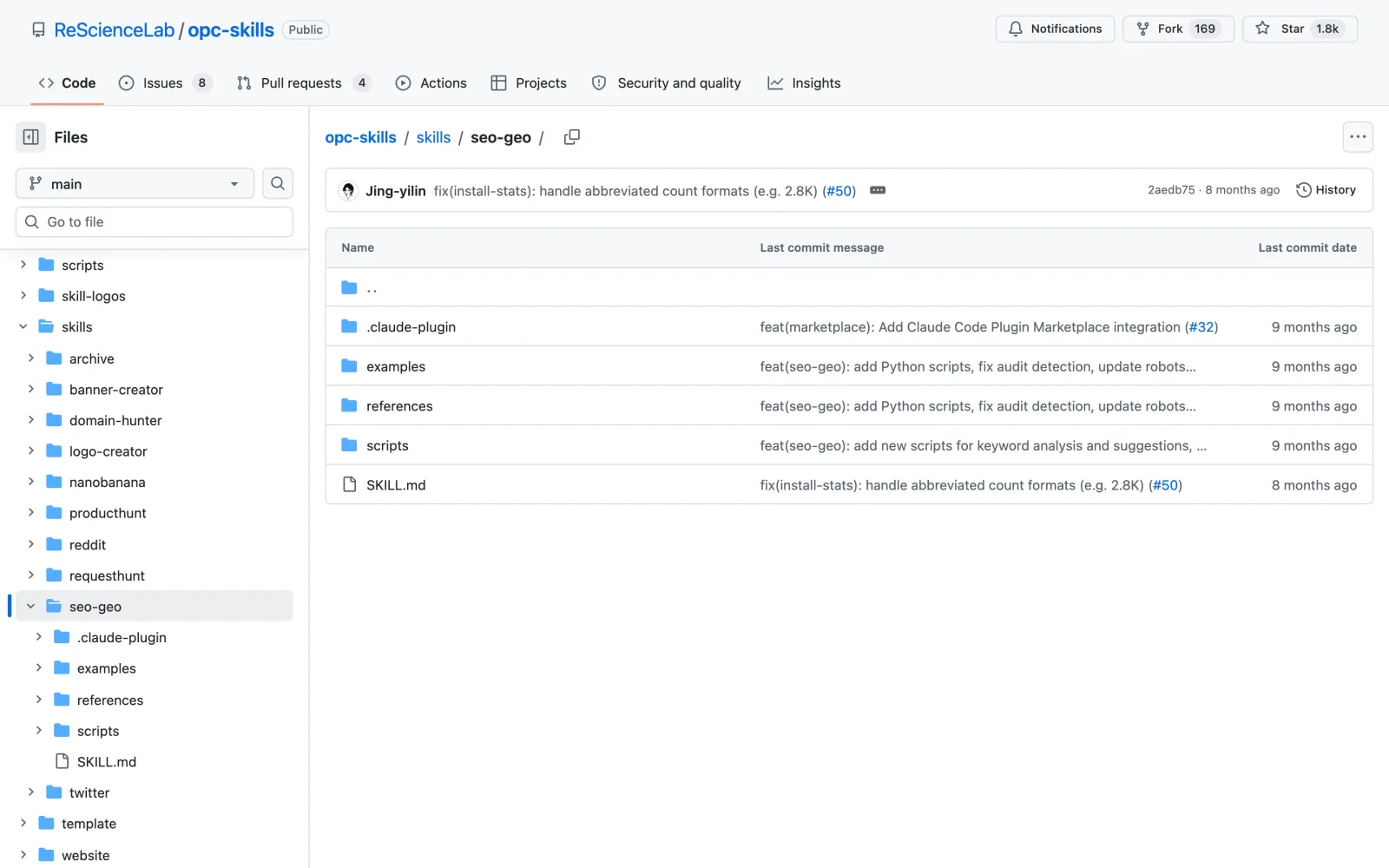
SEO + GEO from the OPC Skills pack covers classic search and AI answers together. GEO, short for generative engine optimization, is the AI version of SEO: making your page the source that ChatGPT, Perplexity, Gemini or Claude cites.
What it does
- A free audit script checks your title, meta description, H1, robots.txt, sitemap and load time.
- Your robots.txt is read to see whether AI crawlers such as GPTBot are blocked.
- Pages get rewritten with nine methods from a Princeton study of what AI engines tend to quote, such as citing sources, adding statistics and including quotations.
- Keyword stuffing gets flagged, since the same study found it lowers visibility.
Example: On a test site with planted problems, the checkup flagged a five-character title, a missing meta description, no H1 and a robots.txt that locked out GPTBot.
The catch: Its keyword step estimates search volume from web searches rather than a data provider, and the study’s gains are averages that your site may not match.
Install it
Easiest: open Claude Code, type Install this skill: and paste github.com/resciencelab/opc-skills/tree/main/skills/seo-geo
npx skills add resciencelab/opc-skills --skill seo-geoStep 5 · AI score
5. GEO-SEO Claude: a GEO score out of 100
10.9K GitHub starsMITFree
Most site owners have no idea whether AI assistants recommend them or a competitor.
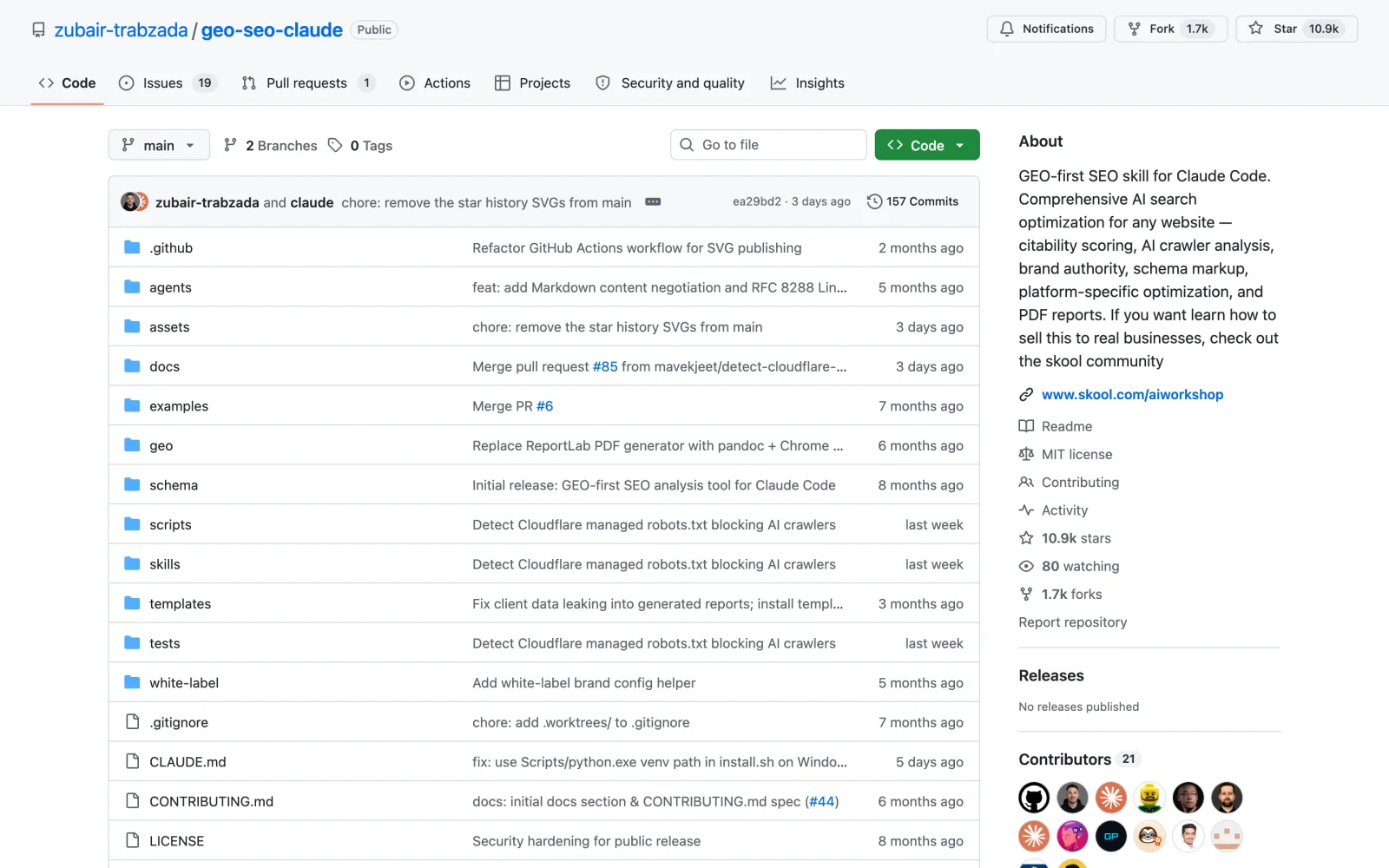
GEO-SEO Claude by Zubair Trabzada puts AI search first and turns it into a score you can track.
What it does
- Running /geo audit on a URL starts five helpers at once: AI crawler access, content quality, technical health, schema and platform readiness for ChatGPT, Perplexity and Google’s AI features.
- The result is one GEO score from 0 to 100 and a fix list ordered with quick wins first.
- Individual paragraphs are rated on how easy they are for an AI to quote.
- Everything can be exported as a PDF report for a client.
Example: Run it on your homepage and you see which paragraphs an AI would quote, which ones it would skip and what to change first.
The catch: It also generates an llms.txt file, but Google’s guidance says Search ignores that file. It needs Python 3.10 or newer.
Install it
Easiest: open Claude Code, type Install this skill: and paste github.com/zubair-trabzada/geo-seo-claude
git clone https://github.com/zubair-trabzada/geo-seo-claude.git
cd geo-seo-claude
./install.shStep 6 · Checkup
6. SEO Audit: the most installed SEO skill
53.2K GitHub stars (pack)220K installsMITFree
When traffic drops overnight, guessing at the cause wastes days.
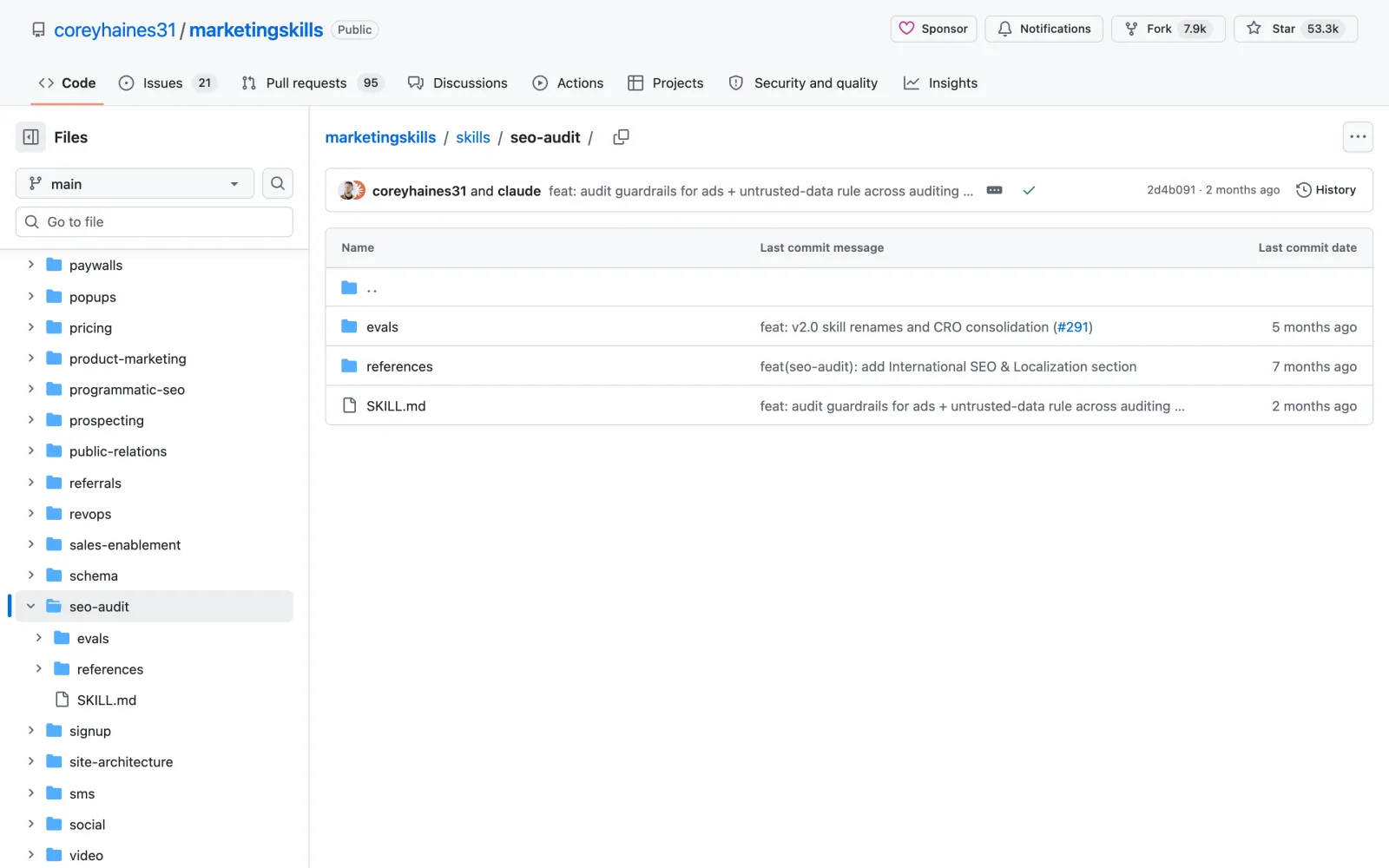
SEO Audit, also from Corey Haines’ pack, is the most installed SEO skill on skills.sh. It runs a checkup in order of importance.
What it does
- First it checks whether Google can crawl the site at all, then whether pages are indexed.
- Next come speed and Core Web Vitals, mobile and HTTPS.
- Then it checks each page’s title, headings, images and internal links, and finally signs of experience and trust (E-E-A-T).
- Every issue is reported with its impact, the evidence, the fix and a priority.
Example: Tell it your traffic fell and it works through the likely causes in that order, so the problem that matters most gets fixed first.
The catch: It reads pages as plain HTML, so schema added by plugins such as Yoast or Rank Math through JavaScript can look missing. The skill itself says to confirm that in Google’s Rich Results Test.
Install it
Easiest: open Claude Code, type Install this skill: and paste github.com/coreyhaines31/marketingskills/tree/main/skills/seo-audit
npx skills add https://github.com/coreyhaines31/marketingskills --skill seo-auditStill building the site itself? Start with my guide to how to build a website with Claude Code.
Step 7 · Full audit
7. Claude SEO: an agency-style audit in Claude Code
18.3K GitHub stars8K installsMITFree
An SEO agency can charge thousands for one full audit. Its own README lists agency projects at $2,000 to $15,000 and up.
Claude SEO by Daniel Agrici brings that kind of audit into Claude Code.
What it does
- Its 26 sub-skills cover technical SEO, content, schema, AI search, local SEO, ecommerce and multilingual sites.
- /seo audit runs up to 17 agents in parallel, so a full audit takes minutes.
- You get a score out of 100 and a plan that starts with the worst problems.
- Each recommendation comes with a check for how you’d know it didn’t work, so you can measure the result. Free Google API keys add real speed data and Search Console numbers.
Example: Run it before you redesign a site and you get a prioritized list of what to fix, each item with a way to prove it helped.
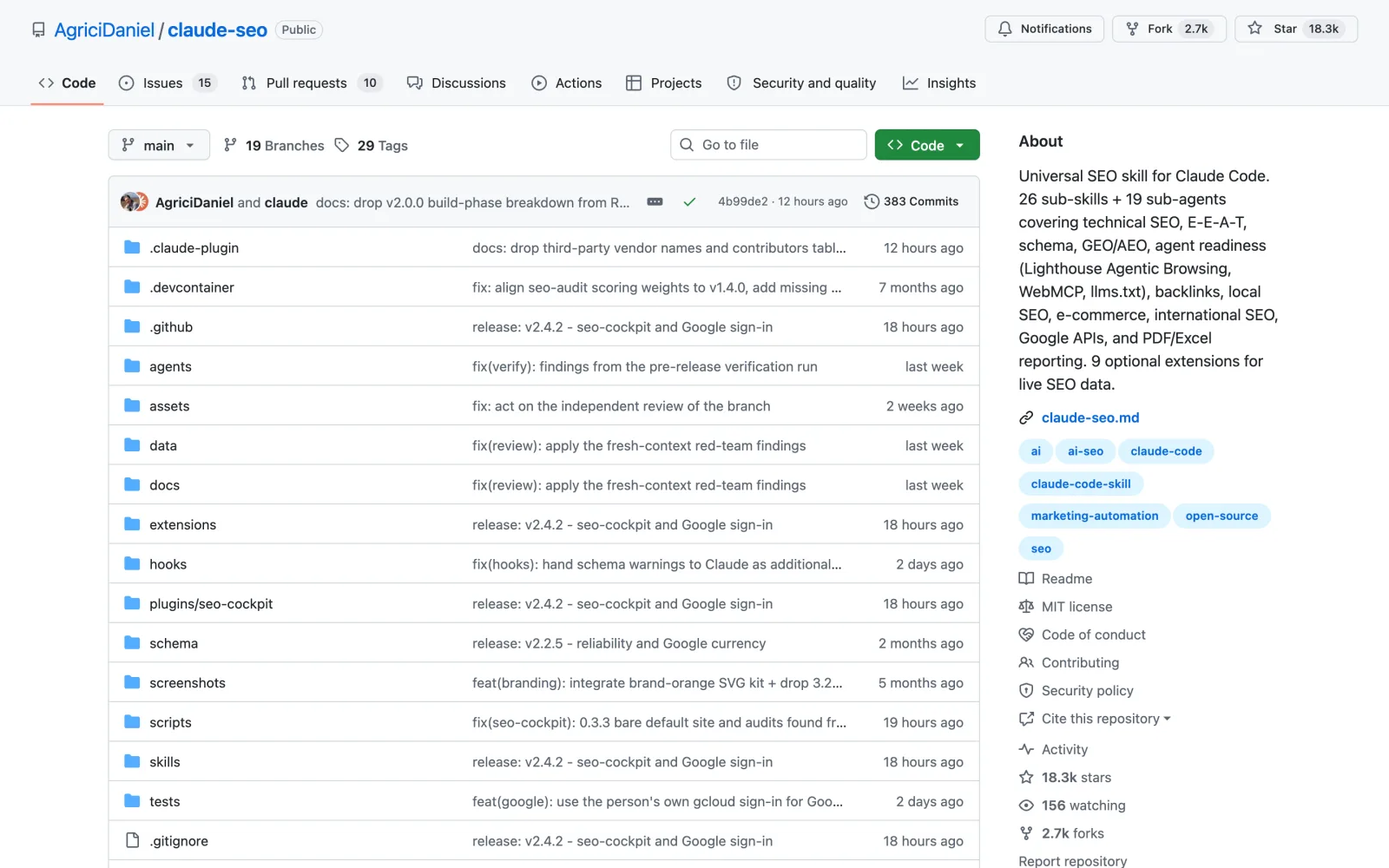
The catch: Setup installs its own Python environment and a Chromium browser. Without Google credentials, speed figures are lab estimates, and the Ahrefs and DataForSEO extensions need paid accounts.
Install it
Easiest: open Claude Code, type Install this skill: and paste github.com/AgriciDaniel/claude-seo
/plugin marketplace add AgriciDaniel/claude-seo
/plugin install claude-seo@agricidaniel-claude-seoHow to install the Claude SEO skills
You don’t have to type the commands yourself:
- Open Claude Code in the desktop app, the terminal or your code editor.
- Type
Install this skill:and paste the skill’s GitHub link from this article. - Claude installs it and explains how to use it. Start a new chat so the skill loads.
- Then ask in plain English, for example “audit my homepage for SEO”.
Each section above also shows the exact command if you prefer to run it yourself.
Frequently asked questions
What is Claude SEO?
It means two things. Generally, it’s using Claude and its skills for search engine optimization, from keyword research to audits. It’s also the name of Daniel Agrici’s open source skill, which runs full audits inside Claude Code. This guide covers both.
Are these Claude SEO skills free?
All seven are free to install. Two need paid data to get the most out of them: OpenSEO uses DataForSEO, which charges per search, and Claude SEO’s Ahrefs and DataForSEO extensions need paid accounts.
What is the difference between SEO and GEO?
SEO helps a page rank in Google’s results. GEO, generative engine optimization, helps a page get cited in AI answers from ChatGPT, Perplexity, Gemini or Google’s AI features. SEO + GEO and GEO-SEO Claude cover the second part.
Does an llms.txt file help with Google?
No. Google’s guidance says Search ignores llms.txt. Some AI tools may read it, so GEO-SEO Claude can generate one, but don’t expect it to change your Google rankings.
Which Claude SEO skill should I install first?
If traffic is your problem, start with SEO Audit to find what is broken. If the site is new, start with keyword research so every page targets a search people actually make.
Final verdict: the best Claude SEO setup
Keyword research decides what each page targets, Programmatic SEO and Schema build and label the pages, SEO + GEO and GEO-SEO Claude get you into AI answers, and SEO Audit plus Claude SEO tell you what broke and what to fix first.
You don’t need all seven. Pick the one that matches your biggest problem today. If your copy needs work too, my guide to Claude copywriting covers the skills for that.